

Zenith Bank Team Tennis tourney finals on centre stage at Ik...
...It’s Prestige Banking vs Diaspora Banking
an hour ago
A new publication traces the journey from Kwara Academical to the 'Harmony Boys,' preserving decades of football history for generations to come




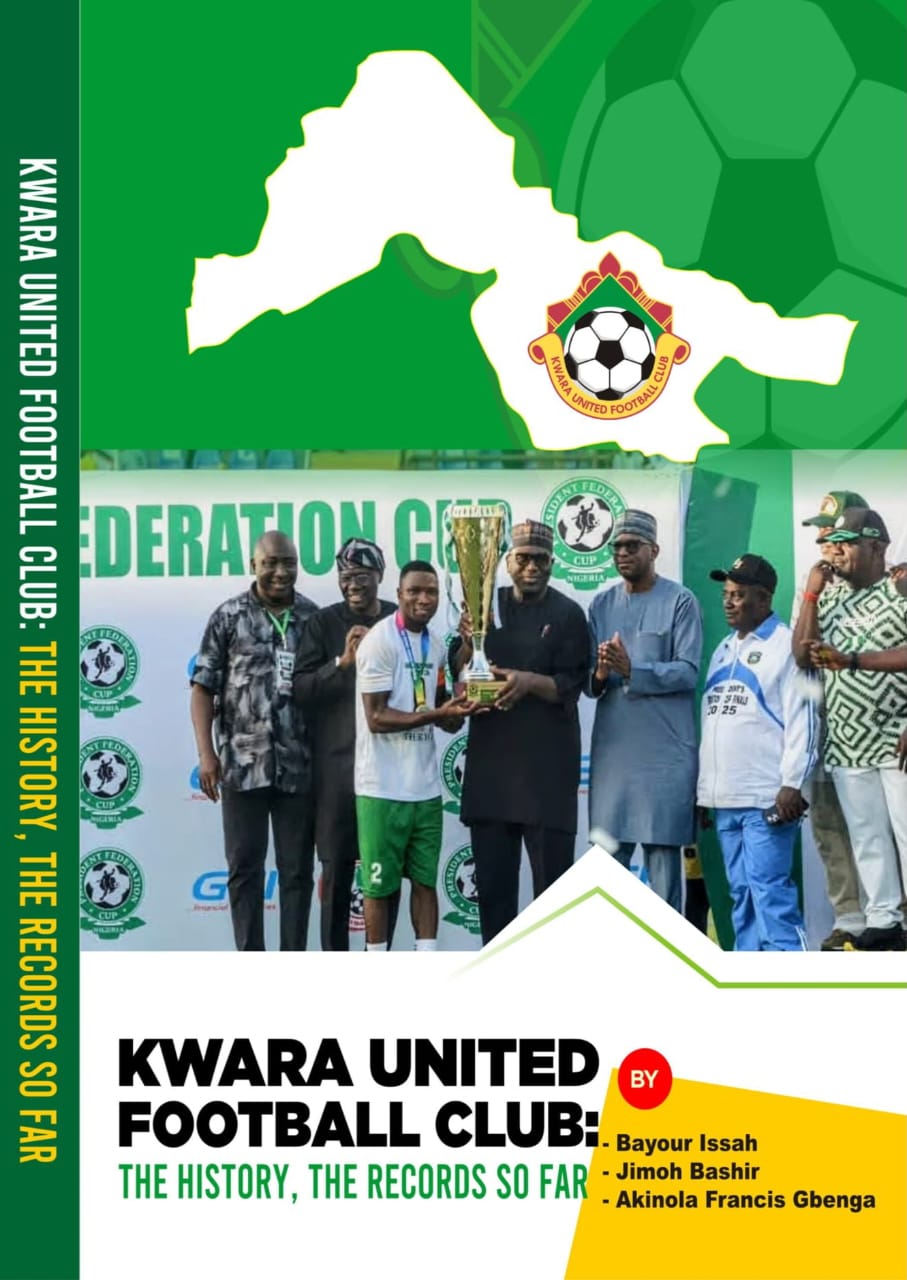
Kwara United: The history, the records so far, a landmark book set for launch in Ilorin
By Gesinde Adedeji Amosa
"A new publication traces the journey from Kwara Academical to the 'Harmony Boys,' preserving decades of football history for generations to come" - Gesinde Fregene
The history of football in Kwara State is about to receive a significant addition. Kwara United Football Club: The History, The Records So Far, a landmark publication documenting the club's evolution, personalities, achievements, challenges, and enduring legacy will be publicly presented on Thursday, August 27, 2026, at the Pa Gabriel Babatunde Ladipo Indoor Sports Hall, Rashidi Yekini Stadium Complex, Ilorin, Kwara State.
The book is the brainchild of veteran sports broadcaster Bayour Issah, popularly known as "Mr Sports" and "The Dean of Sports Faculty." Jimoh Ayinla Bashir, a Sports Editor at The Herald Newspaper served as Coordinating Editor, while Akinola Francis Gbenga contributed substantially to the work's statistical and analytical dimensions.
The significance of this book cannot be fully appreciated without acknowledging just how difficult it has been to document the history of Kwara United Football Club of Ilorin. Several people have attempted this over the years, including this writers, but such efforts have repeatedly run into the same obstacles: scarce records, incomplete archives, conflicting accounts, and the absence of any central repository for the state's football history.
It is against that backdrop that this new work matters. An earlier notable contribution came from Coach Issa Salman, popularly known as "Lanky," a former Captain of the Kwara Water Corporation team and a former Green Eagles player.
His book, Football Development in Kwara State, offered valuable insight into the game's growth in the state and remains an important reference.
Where that earlier work took a broad view of football development across Kwara, this new publication narrows its focus, offering an extensive and deliberate account of Kwara United FC itself, its history, records, management, coaches, players, continental campaigns, supporters, and media officers. Together, these efforts forms important building blocks in ensuring that Kwara's football history is not lost to time.
From Kwara Academical to Kwara United.
One of the book's most commendable features is how it connects the different stages of Kwara's football development. The story does not begin and end with Kwara United; it traces the game from the era of the Kwara Academical and other pioneering structures, through the rise of organised club football, to Kwara United FC as it stands today.
That sweep makes the book more than a club history , it is a record of how football culture itself evolved in Kwara State, bringing together the contributions of players, coaches, administrators, journalists, supporters, and government officials who shaped the landscape along the way.
Putting the material together was no small task. In many cases, records were difficult to locate, and much of what survives exists only in personal memory, old newspaper cuttings, magazines, private collections, and conversations with former players, coaches, and administrators. The team had to consult widely and cross-check extensively to produce a credible historical record- one that now stands as a genuine sports archive and reference work, spanning the full journey from the Kwara Academicals to Kwara United FC, Ilorin.
This book deserves to travel well beyond the bookshelves of football enthusiasts. It should be recommended to schools across Kwara State, particularly where sports history and physical education are taught, and made available to students of sports management, journalism, and history across Nigeria.
A society that fails to preserve its history forces every new generation to start from zero. Young footballers should know who laid the foundations they now build on. Coaches should understand how the game evolved. Administrators should study the successes and setbacks of those who came before them. Journalists need a reliable starting point when researching Kwara football. And above all, Kwarans should know the story of their own football heritage.
I want to particularly commend the writers and Coordinating Editor behind this project. Bayour Issah, Jimoh Ayinla Bashir, and Akinola Francis Gbenga have taken on a task many would consider too difficult, given how thin the historical record is. They have done more than write about football. They have worked to rescue its history from oblivion. Their effort is also a reminder that preserving history is not solely the job of government or formal institutions; anyone who has witnessed or participated in these events carries a responsibility to leave a record behind.
The book unfolds across ten chapters, covering: the history of sports development in Kwara State; the growth of football and club football in the state; the making of Kwara United; its continental campaigns; the Kwara State Football Association; stadia and club management; Chairmen, General Managers, and Secretaries; Head Coaches and Assistants; a season-by-season analysis; and the wider cast of stakeholders, including the Kwara Academicals, Kwara All Stars, Youth Sports Federation of Nigeria, YSFON, ITFA, the Kwara Football Academy, Media Officers, Supporters, Fans, Mascots, and other figures who shaped the club. It also records Kwara United's memorable and controversial moments, presenting the story from multiple perspectives.
Kwara United, popularly known as the "Harmony Boys", has grown into far more than a football club. Over the years, it has become part of the social and sporting identity of Kwara State, offering opportunities to players, coaches, administrators, journalists, medical staff, and supporters alike. The club has represented Nigeria on the continental stage, notably in 1999 and 2026, and has produced talents that went on to make its marks in Nigerian and international football.
Kwara United has yet to win the Nigerian league title, but it ended a 50-year wait for the Federation Cup, lifting the trophy in 2025, half a century after the heartbreak of 1976, when the side lost the final of the then-Challenge Cup to Rangers International of Enugu. Even so, the club's history cannot be measured by trophies alone; its influence on football development in Kwara remains significant in its own right.
The book arrives at a fitting moment, as Kwara United works to reposition and rebrand itself for greater sporting and commercial relevance. Understanding the club's past is essential to building its future. History provides identity. Records provide accountability. Memory provides inspiration. This book brings all three together.
I congratulate the Authors and the Editor on this initiative, and thank everyone who contributed materials, information, encouragement, and resources to see it through. May the book inspire further research and encourage future generations to keep documenting the story of Kwara football.
The presentation on Thursday, August 27, 2026, should mark a beginning, not an end. It should launch a broader campaign to build a permanent Kwara football archive, one where documents, photographs, statistics, interviews, trophies, and newspaper reports can be preserved for good. Future generations should never have to struggle to discover who played, who coached, who administered, who supported, and who sacrificed for football in Kwara. The records must remain.
Kwara United Football Club: The History, The Records has taken an important first step in that direction. Congratulations to Bayour Issah, Jimoh Ayinla Bashir, and Akinola Francis Gbenga on this historic effort. From the Kwara Academicals to Kwara United FC, Ilorin — the story has finally found another enduring home in print.
KWARA UNITED FOOTBALL CLUB: THE HISTORY, THE RECORDS.
Launch Date: Thursday, August 27, 2026
Venue: Pa Gabriel Babatunde Ladipo Indoor Sports Hall, George Agbazika Innih Stadium Complex, Ilorin, Kwara State. History preserved. Records documented. Legacy secured.
Written by Gesinde Adedeji Amosa, fcipdm.
Fellow, Chartered Institute of Public Diplomacy Management (FCIPDM); Associate Sportswriter; Retired Permanent Secretary, Kwara State Civil Service.